Get off the kitchen table!
This behavior makes no sense.
You know you’ll get a squirt,
from the bottle of punishments.
Get off the kitchen counter!
Especially when I’m cooking.
You know you’re only allowed,
up there when I’m not looking.
Get off the kitchen table!
This behavior makes no sense.
You know you’ll get a squirt,
from the bottle of punishments.
Get off the kitchen counter!
Especially when I’m cooking.
You know you’re only allowed,
up there when I’m not looking.
Today’s word is inspired by the fabulous lunch I had this afternoon with colleagues at one of the finest restaurants in Sweden. Sjömagasinet (The Lake Warehouse) is a Michelin starred restaurant that was until recently owned by Chef Leif Mannerström, a world-class chef who is one of the celebrity chef host/judges of Master Chef Sweden. In 2010 he sold the restaurant to Chef Ulf Wagner, another world-class chef who won the Chef of the Year award in 2010. The restaurant just happens to be located a short walk away from where I work, although today was the first time I’d eaten there.
I love food, you see. Everything about it. I love cooking it, reading about it, watching TV shows about it, and especially eating it. The word given to the art and science of good eating is our word of the day: gastronomy. It can also be defined as the study and appreciation of food and culture. A person who is well-versed in gastronomy is called a gastronome. I’m not sure if I’m one yet, but maybe one day…
Today’s lunch was a piece of halibut that was good enough for Jehova. It was perfectly cooked, sitting in a pool of the most beautifully complex lemon butter sauce, and topped with chopped fresh parsley, sun-dried tomatoes, and roasted pine nuts. Oh god…it was so good I had to hold myself back from gobbling it up in two mouthfuls. Instead I took small bites so I could savor every single well-developed flavor in every bite. It was easily the best food I’ve ever eaten in this country, and one of the best meals I’ve ever eaten in my life. Possibly the best.
Now I know where to take my family for lunch or dinner when they arrive in a few weeks. If you’re ever in Gothenburg you simply must try this restaurant. I was blown away by how good the food was.
The English language may have many more words than the Swedish language, but there are some words and phrases in Swedish which don’t really have an equivalent in the English language, and which I particularly love. One of those phrases is “skitbra,” which translates to “shit good.” It’s common in Swedish slang to place the word “skit/shit” in front of the adjective of one’s choice. The word “skit” functions as an auxiliary sentence modifier that emphasizes the meaning of the adjective. Therefore the word “skitbra” means not just good but rather good, thank you very much.
Other uses of the “skit/shit” modifier can be found in the following examples:
1. skitdåligt = shit bad
Den här filmen är skitdåligt! (This film is not very good.)
2. skitkallt = shit cold (referring to the weather/climate)
Fy fan, det är skitkallt idag. (My goodness, it’s cold today.)
3. skitvarmt = shit hot (ditto the above)
Fan också! Det är skitvarmt! (Dear me! It’s rather warm!)
More on Swedish slang and profanities later…
I just read on The Local: Sweden’s News in English, that Ephrem Yohannes, the man convicted of the brutal rape and murder of Elin Krantz, was sentenced to 16 years in prison for his crimes, after which he will be deported from Sweden. He’s also been ordered to pay 600,000 SEK to the victim’s family as compensation, as if mere money could possibly “compensate” her family for her loss.
This is how he has been ordered to pay for his crimes. Whether or not this sentence can be considered “justice” is a another matter entirely.
It seems a rather lightweight sentence to me considering the degree of brutality and ruthlessness of the crimes. Then again I was born and raised in the highly punitive culture of the United States, where citizens demand that lawmakers be as tough as possible on crime. In America, a violent rapist-murderer would receive no less than a life sentence. In some states he might even be sentenced to death. The idea of a violent criminal being sentenced to a mere sixteen years in prison would seem ridiculously lenient to most Americans. Including me.
Still, this is Sweden, where it is believed that every criminal no matter how far gone has the potential to be rehabilitated. I’m not so sure.
I happen to have a different perspective on this particular crime because it occurred practically in my backyard. Elin Krantz’s body was found in the woods next to the public tram stop that I use every single day. I remember like it was yesterday the morning that I walked to the tram stop like usual and noticed that the whole area was cordoned off with blue and white police tape. There were several police cars in the area and my first thought was that they must have found a body.
It didn’t occur to me exactly whose body until I boarded the tram and remembered seeing the notices posted on the inside of the tram stop shelter and on the door of the nearby supermarket. “Have you seen our sister?” the notices read below a picture of Elin Krantz. She went out on Friday night and never made it home. It was then Monday morning. I saw a man on the tram reading a newspaper with the main headline, “Body Found in (my neighborhood).” They hadn’t yet identified the body.
That’s when it hit me. Oh my god. Oh my god. It’s her! The body they found. It’s got to be her.
And sadly, it was.
Migraine, migraine,
Feels like a bullet train,
Running through my head.
Wishing I were dead,
That’s only way I see,
The only possibility,
Of killing all the pain,
From this horrible migraine.
I’m not really suicidal,
But this bad poetry recital,
I simply can’t defend it.
It may cause some of you to end it.
Yesterday at an after-work barbecue party, myself and a few colleagues were trying to come up with as many slang, figurative, and colloquial phrases we could think of for the adjective “intoxicated,” which is the most proper and clinical way of describing someone who has had too much to drink. Some of us were sightly intoxicated when this discussion came up and I found out that it’s difficult to pronounce “intoxicated” when one is intoxicated.
So I’ll have a go:
Drunk
Full som en kastrull (strange Swedish expression that translates to “as drunk as a saucepan.”)
Hammered
Smashed
Wasted
(And my personal favorite:)
Shitfaced
Of course there are more. Many many many more. But I don’t want to have all the fun. What amusing phrases can you come up with?
We cleaned their lockers out today.
Broke the locks and threw away,
All the stuff they left behind.
This may seem a bit unkind,
But we trashed it all,
Except for books.
They will likely,
Give us dirty looks,
When they see,
What we just did.
How we shamelessly got rid,
Of all of their nice stuff,
But life is often tough.
We gave them lots of notice,
And told them we would do it.
We gave them all a deadline,
But many of them blew it.
I’m soft and out of shape and old,
I often forget that, truth be told,
I may not look it, but I am,
Quite old enough to be called ma’am.
I’m overweight and easily bruise,
Though I still get carded buying booze.
I very rarely choose a proper noun as a featured word, but this article over on Dictionary.com about the origins of the state name California really caught my eye. California is a Spanish word so I probably assumed the state was named after some Spanish missionary. However, the story behind the California name is actually quite fascinating.
Apparently, when the Spanish began exploring the Pacific Coast they mistakenly thought California was an island. In fact, some of the earliest maps of this region depict California as separated from the mainland. “This is considered one of the greatest, albeit short-lived, cartographic errors.”
Not only that, they decided name the newly-discovered “island” after the mythical island of California from the novel Las Sergas de Esplandián, “The Adventures of Esplandián,” written by Spanish author Garci Rodríguez de Montalvo.
In the book, the mythical California is ruled by Queen Califa and populated only with female warriors who brandish gold weapons. They even harness their animals in gold because it is the only mineral on the island.
The legend of Califa and her island was well known among New World explorers. In 1536 when Hernán Cortéz arrived in Baja California, he believed he had landed on the legendary island.
Labeling it “California” on the charts led to future explorers thinking this was the actual island from the story, inhabited with Amazon-like women almost drowning in gold. Of course 300 years later gold was discovered in California which led to the Gold Rush, statehood, and the state’s nickname, “The Golden State.”

The State of California's bizarre flag.
Until next time…
Today is the National Day of Sweden. It’s also International Kiss a Swede Day. In the interests of common decency, I won’t tell those of you who don’t already know what “kiss” means in Swedish. Look it up.
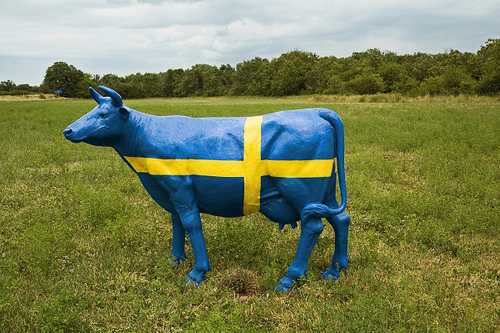
Here is the most random photo I could find.
It’s a fairly low-key day. In fact it didn’t even become a “red day” (that is, a national holiday) until 2005. Swedes, it would seem, are a little uncomfortable with celebrating their Swedishness and tread carefully on their national day.
After all, that could lead to patriotism, which could lead to nationalism, which would naturally lead to National Socialism (Nazis).

